Guides
How Much Coffee to Use: Brewing Methods and Measurements
For a 240 ml French press brew you should expect about 107 mg of caffeine in the cup (dataset value); typical coffee dose for that volume is roughly 16–18 g (estimate) using a 1:14–1:15 ratio.
- Use 1:15 (coffee:water) as a starting ratio — for 240 ml that’s ~16 g of coffee (estimate).
- A 240 ml French press contains 107 mg caffeine; pour-over (240 ml) is 145 mg.
- Caffeine halves every ~5.7 h on average; after 6 h ≈ 48% remains.
- FDA recommends ≤ 400 mg/day for healthy adults; pregnant guidance is about ≤ 200 mg/day.
Coffee measurement basics
Measurement is about two linked decisions: the coffee-to-water ratio (strength) and the total water volume (cup size). Professionals and home brewers prefer weight for repeatability: grams of ground coffee per grams (ml) of water. Where scales aren’t available, tablespoons are used, but density varies by grind and roast.
Common ratios and what they mean
- 1:15 (coffee:water) — balanced, recommended start for French press and general drip.
- 1:16–1:18 — lighter, good for filter and pour-over if you want brighter extraction.
- 1:12–1:14 — stronger, common for espresso and concentrated brew styles.
French press brewing ratios and procedure
French press extraction is contact brewing. Use a slightly coarser grind and longer steep time than pour-over. Recommended starting point: 1:15 by weight — for 240 ml water use ~16 g coffee (estimate); scale to your carafe size.
Steps and timing
- Grind coarse (sea-salt texture), preheat the carafe, add grounds, pour water at ~93–96°C, stir, steep 4 minutes, plunge slowly.
- Adjust: if sour, use hotter water or finer grind; if bitter, coarsen or shorten steep by 30s.
Why weight beats scoops
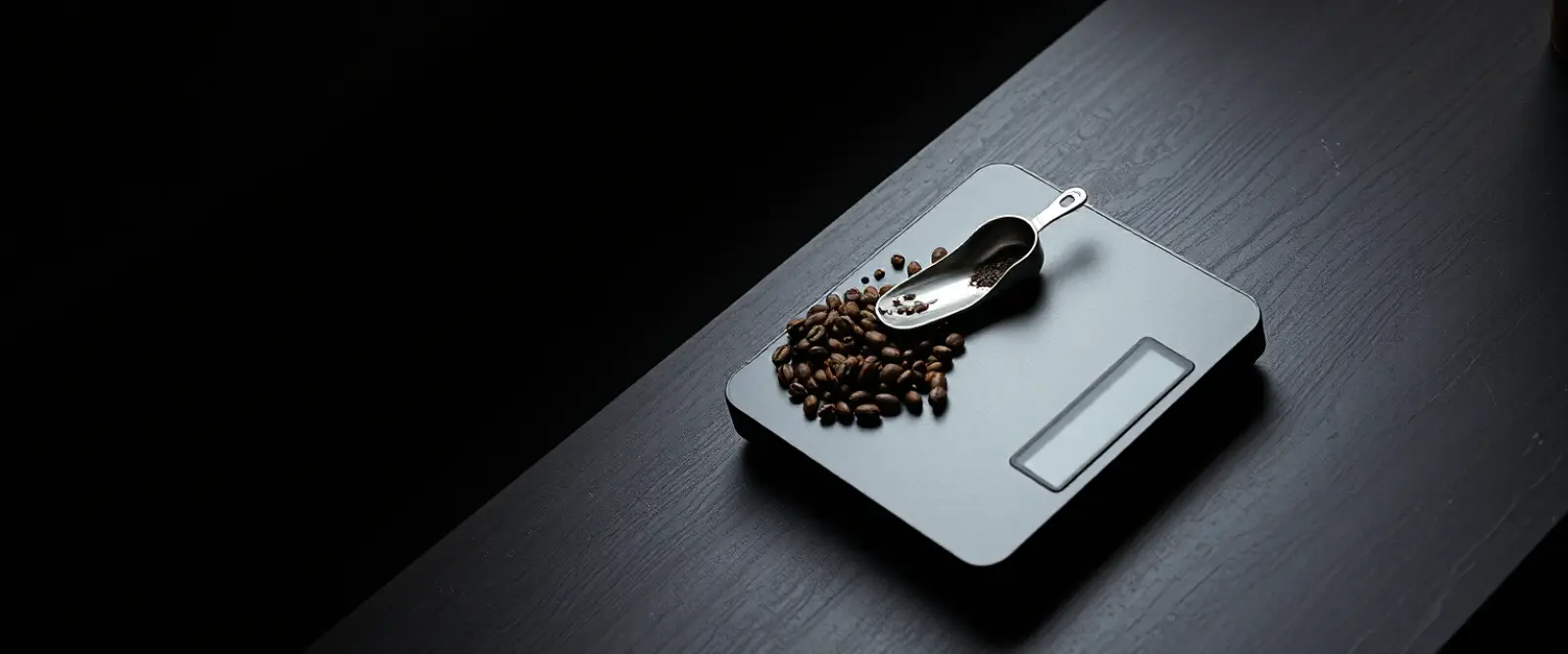
Scoops vary (roast, bean size, tamp), so a kitchen scale giving grams per ml is the only way to reproduce strength precisely. CoffeeLog and similar trackers help record cup size, ratio, and timing so you can repeat preferred results.
Pour-over and drip measurements
Pour-over favors a finer grind and shorter contact time; common home ratio is 1:15–1:16. The dataset shows a 240 ml pour-over containing 145 mg caffeine, higher than drip and French press for identical volumes because extraction and grind produce different solubles.
Practical example
- 240 ml pour-over at 1:16 = 15 g coffee (estimate) — expect ~145 mg caffeine (dataset for 240 ml pour-over).
- For a stronger cup, move toward 1:15 or increase dose by 10–15% rather than forcing a finer grind excessively.
Instant coffee and single-serve proportions
Instant coffee is measured by teaspoons or grams; the dataset lists a 240 ml instant cup with 62 mg caffeine (25.8 mg/100 ml). For most brands, 1 rounded teaspoon (~1.8–2 g) yields a medium-strength cup; increase by half a teaspoon for more body.
Caffeine content by brewing method (quick reference)
Below is a comparison drawn from authoritative dataset values (serving size and caffeine). Use it to pick brew style by desired caffeine per cup.
| Drink | Serving | Caffeine (mg) | mg per 100 ml |
|---|---|---|---|
| French press | 240 ml | 107 | 44.6 |
| Pour over | 240 ml | 145 | 60.4 |
| Drip coffee | 240 ml | 96 | 40 |
| Cold brew | 240 ml | 200 | 83.3 |
| Espresso (double) | 60 ml | 126 | — |
| Instant coffee | 240 ml | 62 | 25.8 |
| Decaf coffee | 240 ml | 3 | 1.2 |
Caffeine decay math — how long it affects you
Use a population-average half-life of ~5.7 hours to estimate remaining caffeine after ingestion. The rough remaining percentages: 3 h ≈ 69%, 6 h ≈ 48%, 9 h ≈ 33%, 12 h ≈ 23%.
| Brew (dose) | 0 h | 3 h (~69%) | 6 h (~48%) | 9 h (~33%) | 12 h (~23%) |
|---|---|---|---|---|---|
| French press (107 mg) | 107 mg | 74 mg | 51 mg | 35 mg | 25 mg |
| Espresso double (126 mg) | 126 mg | 87 mg | 60 mg | 42 mg | 29 mg |
| Cold brew (200 mg) | 200 mg | 138 mg | 96 mg | 66 mg | 46 mg |
Health, timing and safety
For dosing guidance, the U.S. Food and Drug Administration recommends up to 400 mg/day for healthy adults and cites about 200 mg/day as a conservative pregnancy limit; European Food Safety Authority publications give similar guidance. The American Academy of Pediatrics discourages regular caffeine for adolescents. If you have heart conditions, anxiety, or are pregnant, consult a clinician.
Practical timing tips
- Avoid large doses within 6–8 hours of bedtime if you’re sensitive: half-life means meaningful caffeine often remains through sleep onset.
- Use the decay table above to estimate residual caffeine before sleep or evening exercise.
Variables that change how much coffee to use
Grind size, water temperature, brew time, and bean freshness all change extraction. Lighter roasts may taste brighter but contain similar caffeine by weight; darker roasts are less dense so scoop-for-scoop gives different mass. Weigh coffee to control for these variables and log methods in CoffeeLog to compare results over time.
Tools and quick conversion tips
Best tool: a gram scale (0.1 g resolution). If you must use volume: 1 level tablespoon of medium-ground coffee is roughly 5–7 g depending on roast and grind — that’s why weight is preferred. For consistent cups, record ratio, grind, water temp, and time each brew in an app or logbook.
Medical caution: this page is informational only and not medical advice. For pregnancy, heart disease, or medication interactions consult your physician or a pharmacist. Sources referenced in guidance include USDA FoodData Central, FDA, EFSA and Mayo Clinic for pharmacokinetics and safety context.
How many 240 ml French press cups equal the FDA 400 mg/day limit?
Three full 240 ml French press cups (3 × 10⁷ mg = 321 mg) stay below the FDA's 400 mg/day ceiling, leaving room for about 79 mg more before you hit 400 mg. The remainder of 79 mg is roughly 0.74 of another 240 ml French press cup, which equals about 177 ml.
FDA daily limit is 400 mg/day, per the U.S. Food and Drug Administration (2026 guidance summary).
Arithmetic shown: 400 mg ÷ 107 mg = 3.738; 3 full cups = 3 × 10⁷ mg = 321 mg; leftover = 400 mg − 321 mg = 79 mg; fraction of a cup = 79 mg ÷ 107 mg ≈ 0.738; fractional volume ≈ 0.738 × 240 ml = 177 ml. Use the safe daily limit tool to personalise this by body weight or if you consume other caffeinated drinks such as energy drinks listed in our drink comparison.
How should I space French press cups so I don't have too much caffeine at bedtime?
Space full 240 ml French press cups roughly 5–7 hours apart to let the population-average half-life (5.7 hours) substantially reduce circulating caffeine; for example, an 8:00 cup and a 14:00 cup together leave about 53 mg at 23:00. If you want a strict rule, aim to have most of the day's caffeine at least six hours before bedtime because substantial amounts can remain into sleep onset.
First-order elimination is the pharmacokinetic model where a substance decays exponentially with a constant half-life.
Example math using the dataset French press dose (107 mg): remaining after 15 h (8:00 → 23:00) = 107 × 0.5^(15/5.7) = 107 × 0.1616 ≈ 17.3 mg; remaining after 9 h (14:00 → 23:00) = 107 × 0.5^(9/5.7) = 107 × 0.3345 ≈ 35.8 mg; total residual ≈ 17.3 + 35.8 = 53.1 mg. Drake et al. (2013) showed that a 400 mg dose taken 6 hours before bedtime still reduced objective sleep time by over an hour, so planning to cut larger doses earlier is prudent (Drake et al., Journal of Clinical Sleep Medicine, 2013). Use our latest-cup-before-bed tool or the caffeine calculator to test your specific schedule and total intake.
How many grams of coffee should I use in my French press to reach a target caffeine like 150 mg?
To target 150 mg of caffeine from a French press-style extraction you would increase the brew dose to about 22.4 g of ground coffee for a 240 ml cup, assuming extraction scales proportionally. Calculate by scaling the dataset value: 150 mg ÷ 107 mg = 1.4019, then 16 g × 1.4019 ≈ 22.4 g (typical 240 ml starting dose ≈16 g).
Linear scaling is the assumption that caffeine extracted scales roughly in proportion to the mass of coffee used for the same brew method and contact time.
Work shown: scale factor = 150/107 = 1.4019; if you use 16 g as the common 240 ml starting dose, required dose = 16 g × 1.4019 ≈ 22.4 g. Caveat: extraction efficiency changes with grind, temperature and steep time, so this arithmetic is a practical estimate rather than a laboratory result; adjust with small increments and record in a brewing log or use our brewing ratio calculator to get repeatable grams-to-water proportions.
Can I match a 240 ml cold brew's caffeine using French press—what would that take?
A 240 ml cold brew contains 200 mg (dataset value); to match that caffeine amount with a 240 ml French press you'd need nearly double the usual coffee mass — about 30 g of grounds for the same 240 ml. That is roughly 1.87 × the typical 16 g starting dose, so expect heavier body and possible over-extraction if you keep the same steeping time and temperature.
Extraction intensity is the proportion of a bean's soluble material (including caffeine) that ends up in the cup under a specific method and brew parameters.
Math: scale factor = 200 mg ÷ 107 mg = 1.869; grams needed = 16 g × 1.869 ≈ 29.9 g. Alternatively, choose a cold-brew method from our cold brew guide if you want 200 mg without changing cup volume, or split doses into multiple smaller French-press cups to avoid excessive bitterness from pushing a single extraction beyond its sweet spot.
How much French press is safe during pregnancy?
Most authoritative bodies set a pregnancy limit of 200 mg/day; that allows one full 240 ml French press (107 mg) plus about 93 mg extra, so you can have one full cup and roughly 209 ml more (about 0.87 of a second 240 ml cup) before hitting 200 mg. For conservative guidance use low-caffeine options or decaf if you need more fluid without caffeine.
EFSA pregnancy limit is 200 mg/day, per the European Food Safety Authority's 2015 scientific opinion; NHS and the American College of Obstetricians and Gynecologists provide consistent messaging on keeping intake near this level.
Calculation: 200 mg ÷ 107 mg = 1.869; one full cup = 107 mg; leftover = 200 − 107 = 93 mg; fraction of a 240 ml cup = 93 ÷ 107 ≈ 0.869; volume = 0.869 × 240 ml ≈ 209 ml. If you prefer alternatives, decaf 240 ml contains 3 mg (dataset value) so swapping one cup for decaf greatly reduces total caffeine; see our pregnancy caffeine guide for more context and the NIH and ACOG links summarized there.
Bottom line
Decide how much coffee to use in your French press by balancing brew ratio and daily/situation limits: a common starting ratio is about 1:15 by weight (roughly 16 g of ground coffee for 240 ml), and a 240 ml French press yields 107 mg caffeine (dataset value). The U.S. Food and Drug Administration sets a general healthy-adult ceiling of 400 mg/day (FDA), and the European Food Safety Authority sets a pregnancy guideline of 200 mg/day (EFSA, 2015).
Caffeine decays by first-order elimination with a population-average half-life of 5.7 hours; use the formula remaining = dose × 0.5^(hours/5.7) to plan timing. For practical examples: 3 full 240 ml French press cups equal 321 mg leaving ~79 mg to reach the FDA 400 mg limit; two cups spaced 6–7 hours apart often leave modest residuals at bedtime, but avoid large single doses within six hours of sleep to protect sleep quality (Drake et al., 2013). Use our caffeine calculator or last-cup timing tool to personalise volumes and schedules, and consult pregnancy and safety pages such as our pregnancy guide when relevant.
Frequently asked questions
How much coffee do I use in a French press for one 240 ml cup?
Start with a 1:15 ratio: ~16 g ground coffee for 240 ml water (estimate). Adjust ±1–2 g for personal strength; this should yield about 107 mg caffeine per dataset values.
How many tablespoons equal 16 grams of coffee?
A level tablespoon of medium-ground coffee is roughly 5–7 g, so 16 g ≈ 2.5–3 level tablespoons (estimate). Use a scale for precision.
What ratio should I use for pour-over coffee?
Begin at 1:15–1:16; for 240 ml water that’s ~15–16 g coffee (estimate). The dataset records 240 ml pour-over as 145 mg caffeine.
How much instant coffee per 240 ml cup?
Most brands use 1–2 teaspoons; expect about 62 mg caffeine per 240 ml cup per dataset (25.8 mg/100 ml). Start with 1 teaspoon and increase to taste.
How long does the caffeine from a French press last?
Population-average half-life is ~5.7 hours. For a 107 mg French press, about 51 mg remains after 6 hours and ~25 mg after 12 hours.
Is 400 mg caffeine per day safe?
FDA guidance for healthy adults is up to 400 mg/day. Pregnant people are advised to limit to about 200 mg/day; consult your clinician for personal advice.
How much caffeine is in a 120 ml espresso martini?
A 120 ml espresso martini contains 65 mg of caffeine (dataset value).